Home About Portfolio Photo Library Articles & Features
SEARCH
Coffee, Croissants & Cave Diving
Jason Brown journeys to the Lot and Dordogne in the heart of the beautiful French countryside to take on his biggest challenge to date – to become a cave diver.
Learning to cave dive
in the Dordogne...
I've never been particularly keen on driving long distances - even the two hour journey to the south coast from my home in the West Country is something that I far from relish.

Yet here I am - sat in the queue at Portsmouth waiting to board an overnight ferry for an eight hour crossing to Le Havre followed by a further 6.5 hours of non-stop driving - on the wrong side of the road, I might add - to reach the Dordogne in Southern France.
Feature Details
Author:
Jason Brown
Publication Date:
July 2013
Publication:
Sport Diver UK
Feature catagory:
Technical diving
Photo Gallery #1:
Photo Gallery #2:

This feature and all images are copyright © Jason Brown and may not be republished, reproduced or copied in any form without the express written permission of the author. This feature and all images are available to licence.
I've long felt drawn to the prospect of cave diving and caving in general so when the opportunity to join another diver on a full cave course arose, I jumped at the chance. In retrospect, I suspect the excitement of finally getting to cave dive may have silenced the part of my brain that normally reins in such ideas when the reality of excessive travel rears its head. Just for once, I didn't care - I was going cave diving!

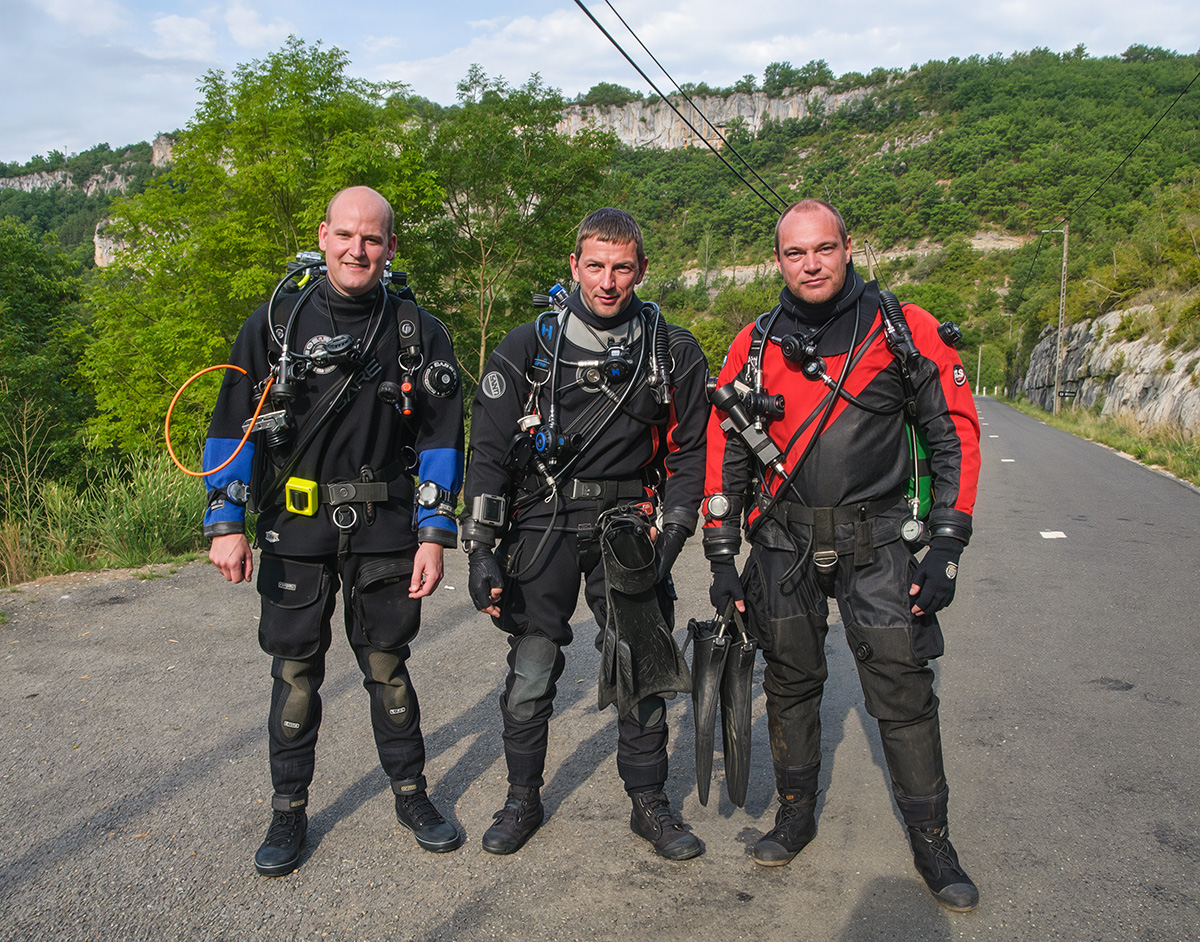
Arriving at our Gîte (pronounced 'Jeet') accommodation - a quaint converted barn in the small village of Payrac - we’re greeted by our instructor, IANTD UK Training Director Phil Short. Known for his passion for all things subterranean, Phil literally lives and breathes caves and is never happier than when he's several kilometres back in an unexplored cave in some remote part of the world. From the dark and muddy sumps of Wookey to the remote phreatic caves of the Siberian wilderness, there are few individuals better placed to introduce us to the world of cave diving.

Two of us would be undertaking the IANTD Full Cave Diver course - myself and fellow trainee cave diver Matt. In addition, we’re joined by tech instructor Howard who would be starting his cave instructor internship - a very long and difficult road for any would-be instructor. Introductions made, we settled in for the night.

Kit fettling...
After a good nights rest, day one saw us up at the crack of dawn for the start of our course. With all the necessary paperwork completed, we start our training with the traditional kit configuration workshop - an opportunity to look at the specific equipment requirements that cave diving places upon the diver and to tweak our own rigs to iron out any issues that could potentially hamper us in the cave environment. Cave diving is all about efficient, streamlined kit so this part of the course is quite important. Whilst my kit seems to escape completely unscathed, Matt's kit bares the brunt of both Phil and Howard's attention - within 5 minutes, it’s reduced to a heap of component parts only to be miraculously rebuilt into something leaner, meaner and far more efficient...
"Being lost in a cave is never good as it inevitably ends in the same, very final outcome..."
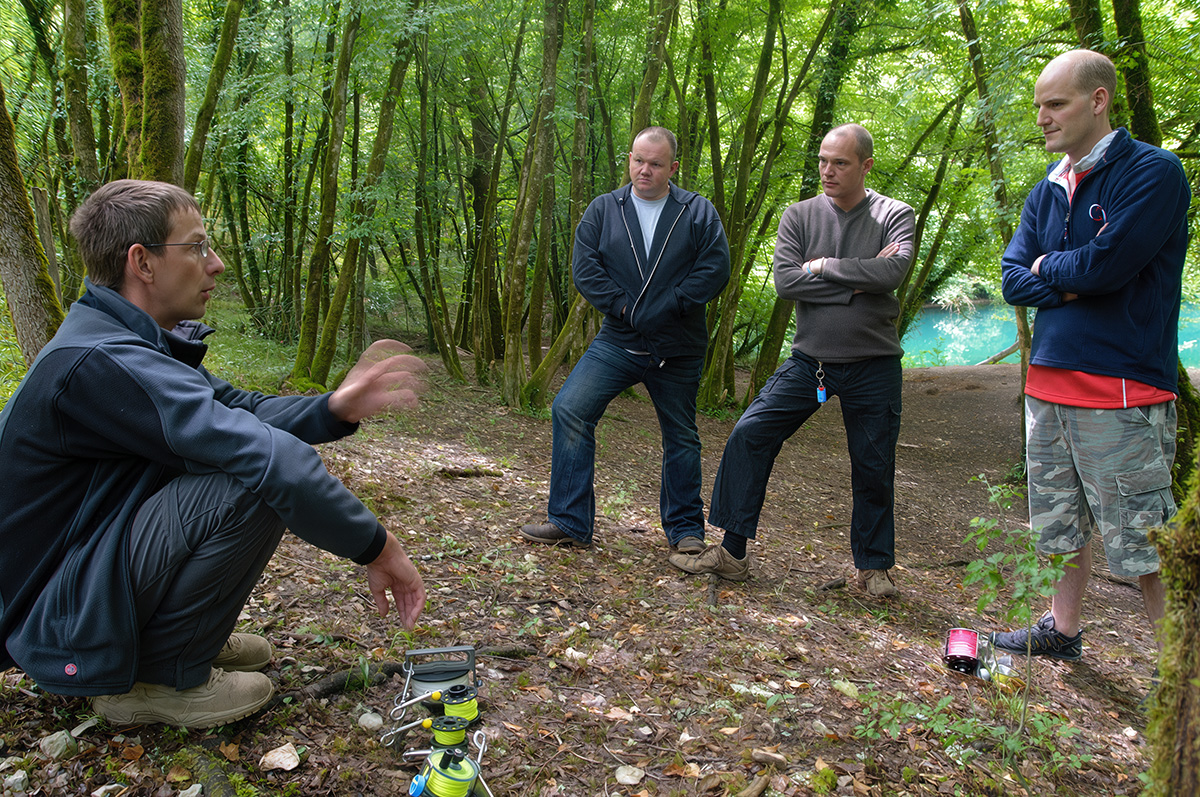
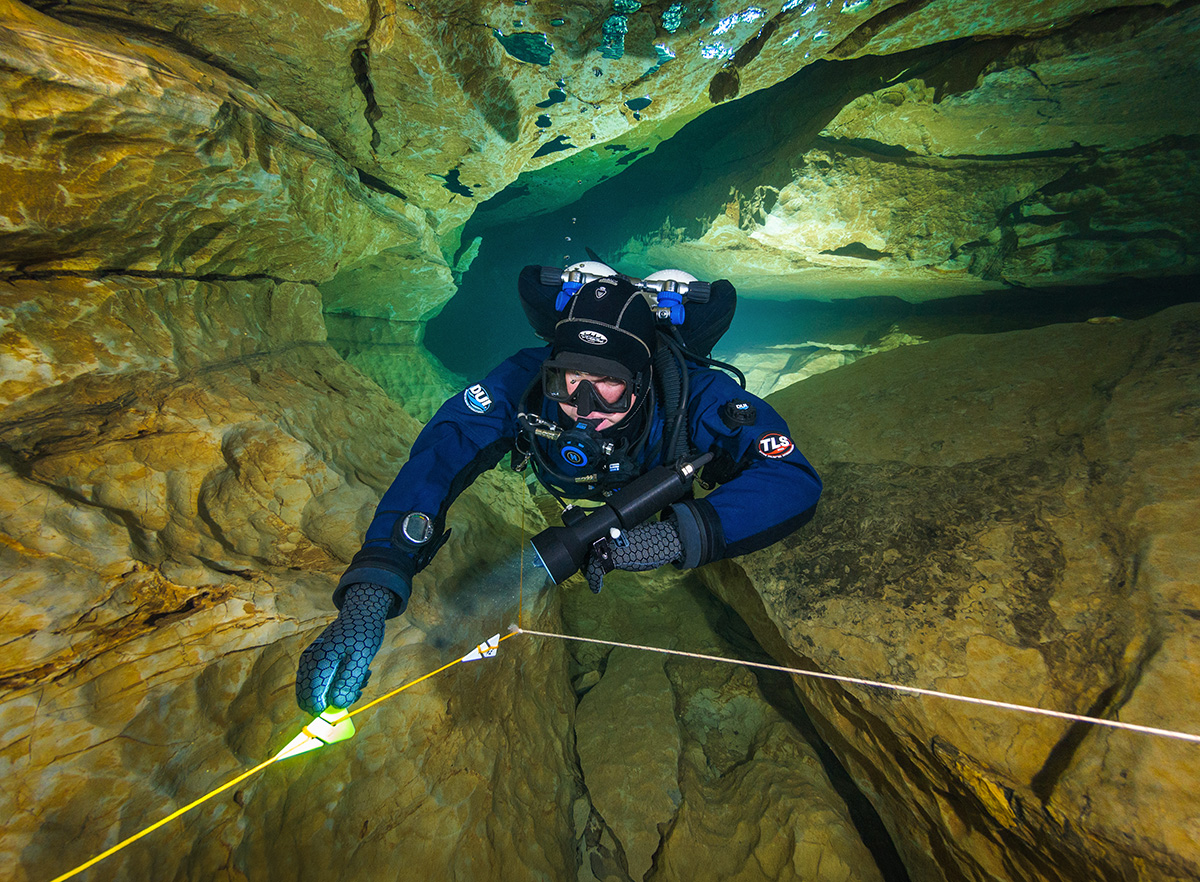
With our kit all sorted, we head out into the French countryside for the first formal part of our cave training - the essential art of line laying. Nature rarely carves conveniently easy to follow caves and without some form of navigation aid, even the most adept cave diver would find themselves lost very quickly. Being lost in a cave is never good as it inevitably ends in the same, very final outcome. To prevent this, cave divers use a continuous guideline that starts in open water and continues throughout your journey into the cave. Many of the ‘tourist’ caves already have these lines in place but the cave diver still needs to understand the protocols involved and how to use this ‘mainline’ to aid their own navigation.

Learning to lay line
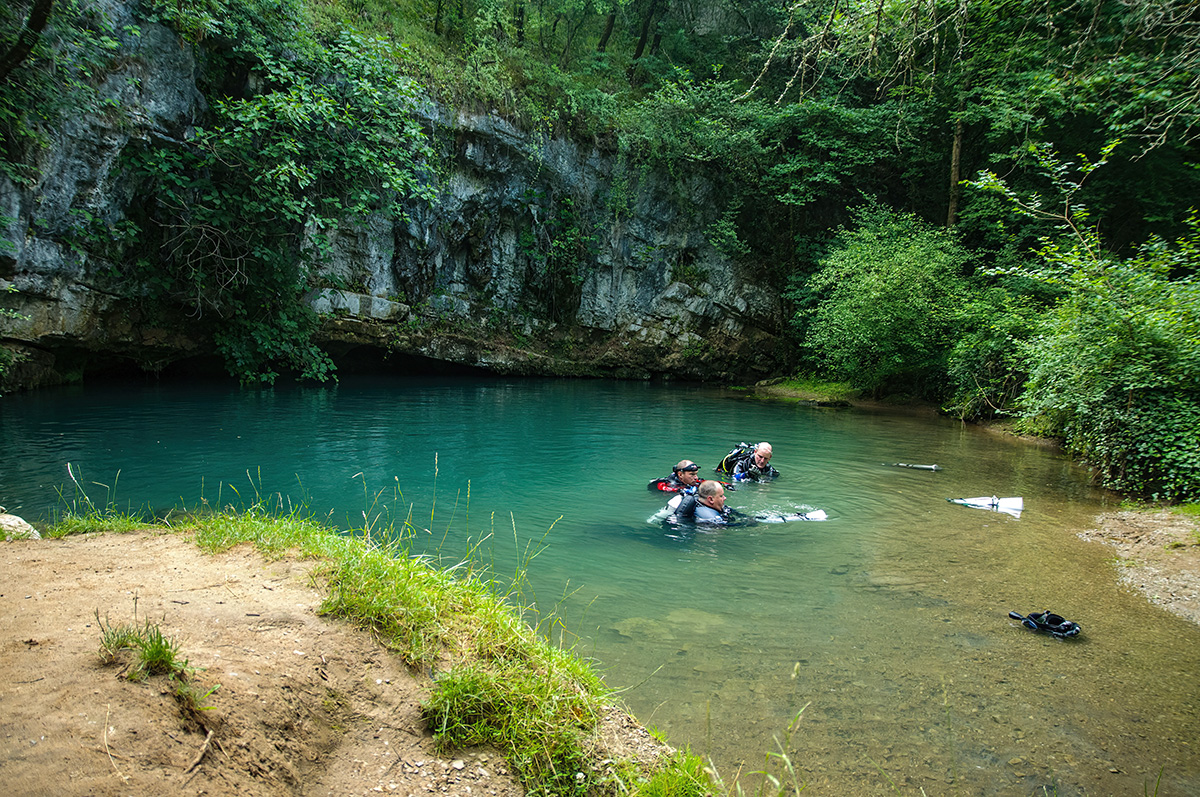
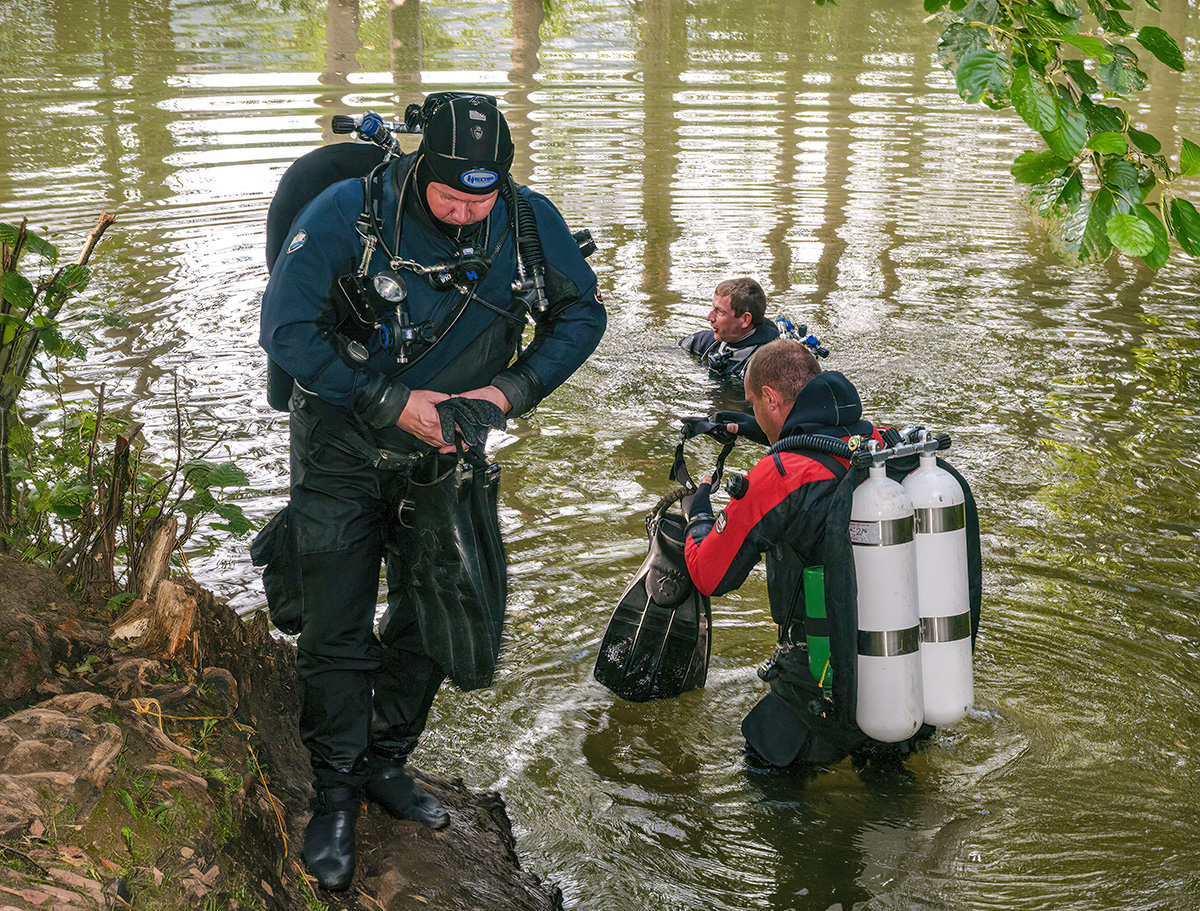
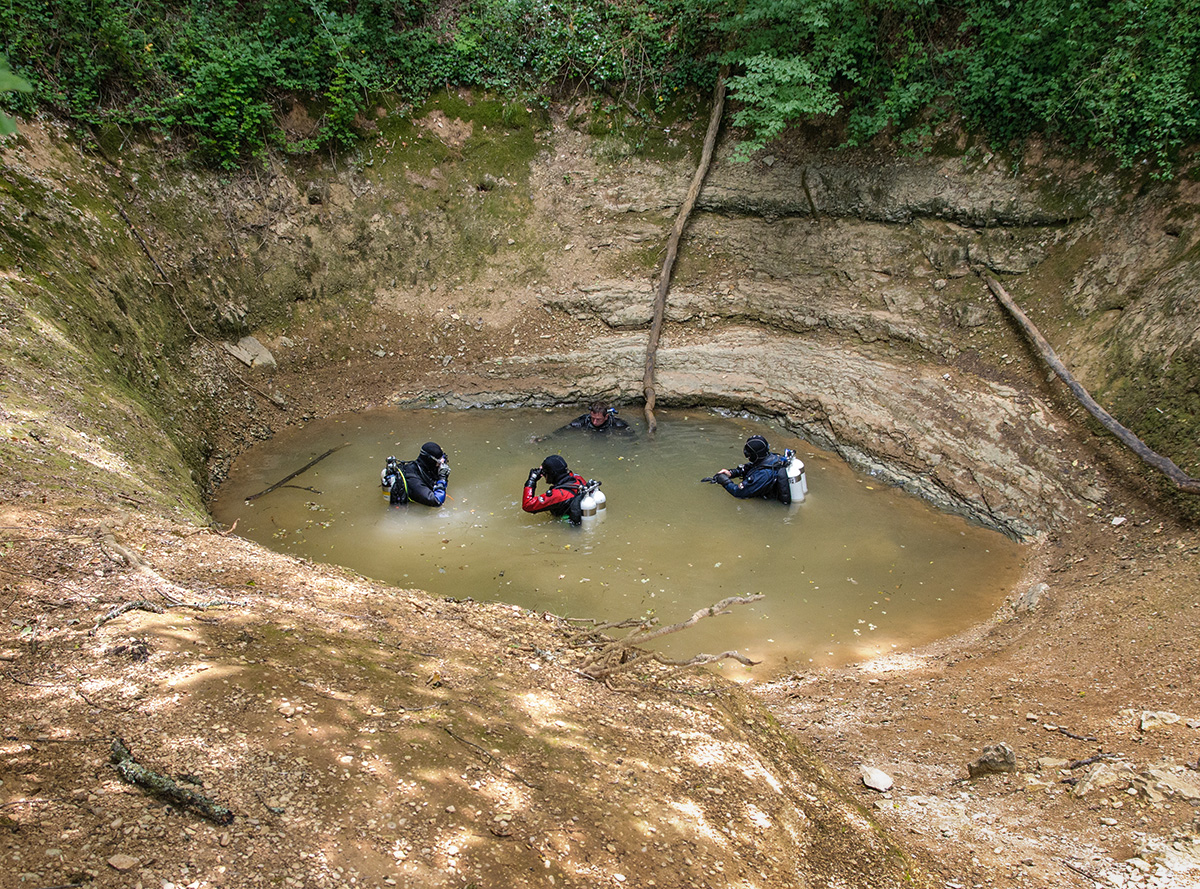
Parking up at the bottom of a remote country lane, we walk the short distance to the head pool at St-Sauveur. Surrounded by a thick canopy of trees, this stunning location is the perfect place to learn line laying as we weave a spider's web of line through the surrounding woodland. We also learn how to follow the line to the exit whilst completely blind using touch contact to communicate. Stumbling through the woodland with our eyes completely covered by ‘black out’ masks, this comical exercise prepares the would-be cave diver for something far more serious in a real cave environment – zero visibility or the loss of a diver’s mask. It’s at this point most divers realise just how much of a life saver the guideline really is...

Both Matt and myself had previously learnt the fundamentals of line laying within both wreck and cavern environments but full cave takes these skills to a whole new level. Whilst the use of a primary reel is very similar, full cave introduces additional reels into the mix - jump reels, gap reels and a safety reel for when things go a bit Pete Tong. Plus, of course, there are those illusive little line arrows and 'cookies' (non-directional markers) that cave divers rely so heavily on - all these and more are discussed at great length.
Entering St Sauveur
With all this theory still spinning in our heads, there was to be no let up in the pace as we wake at 6am the next morning for our first day of in-water training. Returning to St Sauveur, our first dive of the course would take us tantalisingly close to the cave entrance. Sadly we wouldn’t be going in, though, as the next 80 minutes would be spent running through a skills circuit to ensure that our core skills were up to check. With both Matt and myself already trimix-trained, many of the skills were already suitably embedded so we cruise through the drills without too many issues. The final skill, though – scuba unit removal underwater – does provide a few chuckles as removing and replacing a heavy twinset on a steep slope proves to be a lot more challenging.

With Phil confident that we’re not complete numpties, the moment had finally come for our first taste of cave diving. Reentering the head pool at St-Sauveur, we frog kick our way down towards the cave entrance with Phil leading, Matt second, myself third and Howard bringing up the rear. St-Sauver slopes to depth quite rapidly so this first taster would see us going no further than a short distance past the first constriction 60 metres inside the cave. Dropping our stages shortly after the constriction, we continue into the cave with Phil pointing out scalloping - small dish-shaped depressions in the rock formed by eddies in the flowing water - and intricate goethite formations – an iron-oxide mineral that covers the walls like a black spiders web set against the stark coniferous limestone walls of the cave itself.

Our first cave dive was to be a gentle introduction with no skills or drills to worry about. From this point on, though, each new day would follow a familiar pattern with a first dive giving us an opportunity to work on our team protocols, communication, awareness and navigation skills with Matt and myself taking it in turns to play the role of ‘line man’ (the first diver into the cave that leads the dive) or ‘light man’ (the second diver in responsible for aiding the line man and providing light whenever he needs to place or remove a line arrow or cookie). Our second dive of the day, however, would focus on new cave-specific skills.
"Not only had we failed to reach the exit but we’d both run out of gas. Despite remaining in touch contact with Matt, I’d even managed to stray across onto a second line that crossed our line further down the passage. Make no mistake - we were both dead..."
Becoming a cave diver brings with it a host of new skills that must be mastered in order to safely explore the cave environment. In addition, effective gas management is a must to ensure that you’ve got enough gas to safely complete the dive with a healthy reserve held back ‘just in case’. As we were to discover on a skills dive at St-George, even the seemingly generous gas reserve that the ‘rule of thirds’ system provides doesn’t feel like anywhere near enough when things go horribly wrong – thankfully our ‘emergency’ was entirely simulated for the benefit of training but it still felt no less real.

Briefing us thoroughly before we enter the water, our skills dive at St-George would see us putting the touch contact and blind exit skills we’d learnt in the woods at St-Sauveur into practice. The dive starts well enough – as briefed, I am to act as line man as I slowly lay out a guideline from open water and into the 2 metres high mouth of the cave 10 metres beneath the surface. With both primary and second tie offs safely in place, we make our way slowly down the pebble-strewn cave passage to an elbow at a depth of 29 metres. Continuing on past the elbow to a shallower section of the cave further in, we drop our stages and I tie off the line so that the drill can begin.

Blind exit...
With both of us in contact with the line, Phil hands us our mask covers. With one hand holding onto the line for all I’m worth, I slowly move forward to establish contact with Matt who I know will be in front of me on the line. With contact established, a quick push forward is enough to signal to Matt that we should start to move forward. Within a matter of seconds we reach our stages which we attempt to identify and restow through touch contact alone. Feeling the face plate on my second stage, I move my hand to the first stage and then down the tank to the bungee loops that hold the regulator hose in place. It’s vitally important that neither of us pick up the wrong cylinder – breathing someone else’s gas could be a fatal mistake!

Very quickly it becomes obvious that our pace simply isn’t quick enough with both of us stopping to check line arrows and obstructions through touch contact alone. Still we continue until Phil eventually stops the drill. Not only had we failed to reach the exit but we’d both run out of gas. Despite remaining in touch contact with Matt, I’d even managed to stray across onto a second line that crossed our line further down the passage. Make no mistake - we were both dead...
Emergence de Ressel
Determined not to repeat the mistakes we’d made at St-George, the next day finds us at the Emergence de Ressel – perhaps France’s most famous cave system. A spectacular cave that surfaces (if you can call it that) directly beneath the river Célé, entering Ressel is a spectacular experience as you drop through the muddy brown river water into the crystal clear water exiting the cave less than a couple of metres beneath the surface. We’d already spent a day at Ressel earlier in the week practicing gas drills and successfully managing not to die (again) whilst performing the all-important ‘lost line’ drill. This time, however, the pressure would be ramped up as we push further into the cave and make another attempt at the blind exit drill.

For this dive, Matt would be line man with me taking on the light man duties. We follow the main line down through the murky brown river water into the crystal clear waters of the cave and make our way along the 150 metres of clean-washed limestone passage until we reach the first ‘T’ (two-way junction). Dropping our stages shortly before the junction, Matt places a line arrow on the exit side of the line before leading us off along the deep route towards a jump line set a couple of metres away from the main line. With me providing light, Matt runs a reel across to the jump line and we follow it off the main line up through a vertical chimney to a shallower section of the cave 10 metres above us. Running a second jump line to rejoin the main line, we then continue into the cave towards the second ‘T’. Placing a second line marker at the junction, we briefly journey on until we reach the top of a large shaft that drops to 45 metres before gradually descending to a maximum depth of 55 metres (and deeper further in).

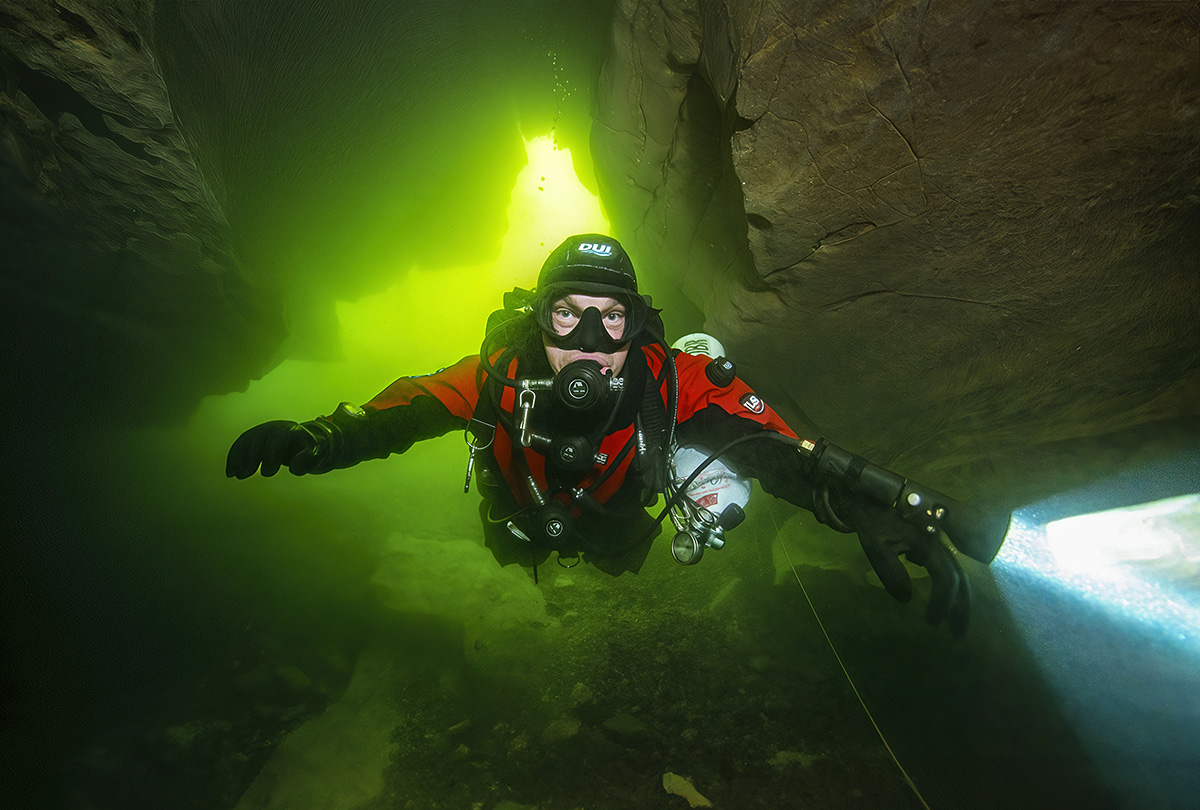
Turning the dive as we hit our first third of gas, we switch team order and start making our way out following a ‘figure of 8’ route back along the deep route, up through the chimney to the shallow section (removing jump reels as we go) and then back to the first ‘T’. Picking up and switching back onto our stages, we slowly make our way back along the main passage towards the exit. As we approach the final leg of our journey, we switch off our primary lights and take in the fabulous sight of the green glow of the cave exit before us – a sight that never fails to leave even the most experienced cave diver speechless. Ressel truly is a magical place.
Our second dive of the day at Ressel wasn’t going to be quite so relaxing as we faced the prospect of having another go at performing a blind exit. To make things a little more fun, one of us would also be out of gas. Making our way back into the cave, we stop 100 metres or so in and make contact with the mainline as Phil hands us the mask covers. This time, though, I’d be leading the exit with Matt behind me communicating through touch contact. With contact established, we waste no time moving rapidly along the mainline towards the exit.

Dive to survive...
Moments later, Phil taps me on the head which means only one thing – I’m now out of gas. Maintaining contact with the main line, I grab Matt’s hand and squeeze it rapidly, signaling to him that I need gas and I need it now! Reacting instinctively, Matt places his long hose regulator into my hand which I begin breathing from. Emergency averted - we continue along the main line towards the exit. Everything seems to be going well until I manage to wedge myself between the ceiling and a large rock – even this doesn’t phase us, though, as I back-track and climb over Matt to reestablish touch contact so that we can continue our progress towards the exit. We’d made it – not only are we alive but we’d even forced Phil and Howard to break a sweat keeping up with us!
"If you’re the sort of diver that suffers from claustrophobia or simply worries about scratching your tanks then a dive at Truffe is not for you..."
Fontaine de Truffe
Our final day of the course would find us parked on the grass verge near a cave that I’ve always wanted to dive – Fontaine de Truffe. Much smaller and more claustrophobic than the caves we’d already dived, Truffe is famous for its stunning geology and crystal clear water. Unfortunately this natural beauty does come at a price for Truffe is also one of the most difficult caves to enter, requiring the diver to literally drag themselves through a very tight passage with their face pressed into the gravel to ensure clearance with the cave roof. If you’re the sort of diver that suffers from claustrophobia or simply worries about scratching your tanks then a dive at Truffe is not for you – few get through without picking up a few ‘battle scars’ on their kit!

Floating on the surface of the muddy head pool, Phil enters the cave first followed by Matt and then myself. Maneuvering past a large rounded off rock in the floor of the cave entrance, I grab the main line – a thick rope in this section of the cave, thankfully – and pull myself through the zero viz with my face pressed into the gravel. I can hear my tanks scraping along the cave roof but there’s no going back so I continue thrashing to move myself through the constriction. Eventually I pop out into the cave interior to be greeted by the other members of my team. After a quick valve check, we begin making our way down the cave passage with the nagging thought that we’ve got to go back through that constriction to exit the cave still ringing in my head!

Triple-distilled Vodka
We’d been blessed with pretty good viz in all the caves we’d dived so far but the viz in Truffe was simply breathtaking – we’re talking triple-distilled vodka pure! Within the tighter confines of Truffe, we’re able to really appreciate the intricate scalloping and the formations that it produces in the soft limestone rock. 160 metres into the cave, we surface into a section of dry cave at the end of sump 1. Many divers turn around at this point but not us – we climb out of the water in full kit and make our way through a section of dry cave (mostly walking but one section does require us to crawl on our hands and knees due to the low ceiling) to the start of sump 2.

Dropping into the water, it’s immediately obvious that this section of cave is a lot tighter still with barely enough room to maneuvre. The three of us switch to ‘pull and glide’ to propel ourselves through the cave taking in the fabulous cave around us. After a further 180 metres underwater, we reach the end of sump 2 and surface at the base of a deep rift. Due to the low water level, this is as far as we can go – our penetration of Truffe has sadly reached its end.
We know something’s going to go wrong – a member of our team is going to become lost within the cave. Where and when this will happen is unknown but we’re prepared for it. Making our way back through sump 2 and then back into sump 1, it doesn’t take long for us to suddenly find ourselves a man down. Realising that Phil is no longer with us, Matt signals to me with his light and I turn to face him. After establishing the problem, we cover our lights in the hope of spotting the feint glow of our team member’s light. Failing to spot our lost team member, we place a line arrow and a switched-on backup light onto the main line and continue our exit searching above, below and all around us.

Stuck, tangled and narked...
Thankfully it doesn’t take long for us to find our lost buddy who is definitely not having a good day – he’s not only become separated from us but he’s also had a complete light failure and then manages to run out of gas at the very moment we find him! Matt reacts rapidly and passes his long hose to Phil as we switch team order to allow him to lead the pace of exit. With myself now at the rear, we head steadily back out of the cave. Reaching the exit, Phil ends the drill and switches back onto his own gas and I then start making my way back out through the constriction towards daylight.

They say getting into Truffe is more difficult than getting out but it certainly doesn’t seem that way – feeling myself wedged solid between the gravel floor and the limestone ceiling, I attempt to give myself a little bit more wriggle room by literally shoveling gravel away from my chest area using my bare hands. It seems to work – I’m able to move forward again. After what seems like an eternity, I reach the head pool, ascend to the surface and breathe a sigh of relief as I take my first lung full of fresh air.

With divers out of the water and safely back on dry land, Phil congratulates us on a job well down – we’ve both qualified as IANTD Full Cave Divers. It’s been a long but very worthwhile week. It’s had its ups and its downs but despite the mental and physical stress and sheer hard work, the beauty of the caves we’ve dived never ceased to take my breath away. Cave diving certainly isn’t for everyone but for those brave few that give it a try, the opportunity to explore and visit places deep within the earth that few will ever see is a truly humbling experience.
All content © Jason Brown 2010-2026
No content may be reproduced without express written permission.