Home About Portfolio Photo Library Articles & Features
SEARCH
The Coronation Cannonball Run
Most wrecks of 'historic significance' tend to be off-limits but the 300 year old wreck of the Coronation is accessible to all. Jason Brown pays her a visit...
Diving into maritime history
on the Coronation Wreck...
All wrecks have a story to tell. Like a sunken time capsule just waiting to be discovered, they capture a moment in history that, with a little digging, can reveal so much about the history of the time and its people.

More often, though, wrecks raise more questions than they answer. What was the vessel doing in the area she now rests? Why did the vessel founder? And – more poignantly – what happened to the crew? It’s these stories that makes shipwrecks so much more than the sum of their wreckage.
Feature Details
Author:
Jason Brown
Publication Date:
April 2017
Publication:
Scuba Diver UK
Feature catagory:
Shipwrecks
Photo Gallery #1:

This feature and all images are copyright © Jason Brown and may not be republished, reproduced or copied in any form without the express written permission of the author. This feature and all images are available to licence.
Located to the west of Penlee Point near Plymouth, the historic wreck of the Coronation has a fascinating story to tell and more than a few mysteries just waiting to be solved. Often overlooked by divers visiting more contemporary wrecks like the James Eagen Layne, HMS Scylla and the Maine, the Coronation wreck site offers divers the opportunity to explore the remains of a historically important vessel bristling with cannon that has lain on the seabed for well over 300 years. Although most of the vessel’s superstructure has long since disappeared, what remains is a treasure trove of history including some of the most impressive cannon you’ll find outside the halls of the British Museum.

A short but illustrious career
The Coronation was a second-rate ship of the line launched in 1685 by Master Shipwright Isaac Betts of Portsmouth. Commissioned in 1690, she served under Captain Charles Skelton. She saw action against the French in the infamous Battle of Beachy Head later that same year. At 50 metres long and with a beam (width) of almost 14 metres, she weighed a staggering 1300 tonnes with a crew of over 600 able seamen. Like most second-rate ships of the time, she boasted three continuous gun decks. She packed quite a punch too with ninety cannon of various sizes ranged against potential targets. The largest of her cannon – twenty-six ’32 pounders’ – could cause some serious damage to any enemy vessel unlucky enough to cross her in battle.

Little more than a year after being commissioned into the Royal Navy, tragedy would strike. In the late Summer of 1691, the Coronation was part of a fleet commanded by Admiral Edward Russell that was tasked with blockading the French Navy in port. With the fleet off Ushant - a small island off the coast of Brittany - the weather took a serious turn for the worse and Russell’s fleet was forced to turn tail and make for the safety of Plymouth Sound. But with hurricane force winds blowing across the Sound from the South West, the fleet was lashed by torrential rain and forced to take in all sails. With no breakwater to protect them at that time, Plymouth Sound was a death-trap.
"The destruction of much of Russell’s fleet rocked the nation – in just one night, nature had achieved more than the French Navy ever could."
As the night wore on, many of the ships in Russell’s fleet would succumb to the maelstrom but the circumstances that surrounds the Coronation’s loss still remains a mystery to this very day. What we do know is that she was anchored somewhere between Penlee and Rame when her anchor cables parted. With her masts torn down and no sails to provide any control over her fate, she capsized and was driven aground to the west of Penlee Point into Lady Cove.

With over six hundred souls lost on the Coronation alone, the destruction of much of Russell’s fleet rocked the nation – in just one night, the unrelenting force of nature had achieved more than the French Navy ever could.

First discovery
The wreck of the Coronation would lay undisturbed for almost 300 years until she was finally discovered in 1967 by dive buddies George Sandford, Alan Down and Terry Harrison whilst diving together off Penlee Point. There they stumbled across some cannonballs - not unusual in itself but exploring further, they found one cannon, then another and then lots of cannon – all lying clustered together in what would become known as the Penlee Cannon site.

Over the next ten years, marine archaeologists surveyed the site extensively in an effort to positively identify what was clearly a significant find.

With the wreck’s identity still a mystery, it wasn’t until 1977 that positive proof was finally discovered when Peter McBride located a second cannon site nearby containing sixteen cannon and three large anchors. Several days later, McBride would find the proof he needed to finally put the wreck’s identity to bed – a pewter plate bearing the coat of arms of the Lieutenant Governor of Plymouth, Sir John Skelton – the father of the Coronation’s Captain, Charles Skelton. Looking to protect the site from interference, McBride applied for a Wreck Protection order that made it illegal for anyone to dive his cannon site without permission.

The Coronation Wreck Project
To this day, McBride’s protection order remains in place. The site is now managed by a dedicated team of volunteers actively working together on the Coronation Wreck Project. Access to the site is strictly controlled and can only be gained either by booking onto one of several approved local charter boats or by contacting the project directly. In charge of managing access is diver Mark Pearce. As the visits licencee, it’s Mark’s job to control access to the site to ensure that all legal requirements as set out by English Heritage are adhered to.

We asked Mark why his role is necessary. “The site is protected because it’s a wreck of national importance, and as such, needs to be protected from pilfering, disturbance and interference. Although diving is permitted, we maintain a strict no touch or removal policy. This means that the wreckage will be enjoyed by future divers in its current position”. Despite the serious tone, Mark and the team actively encourage divers to visit the site. When time allows, Mark even offers the occasional guided tour complete with laminated wreck site maps for each buddy pair to aid navigation around what the project refers to as its ‘diver trail’.
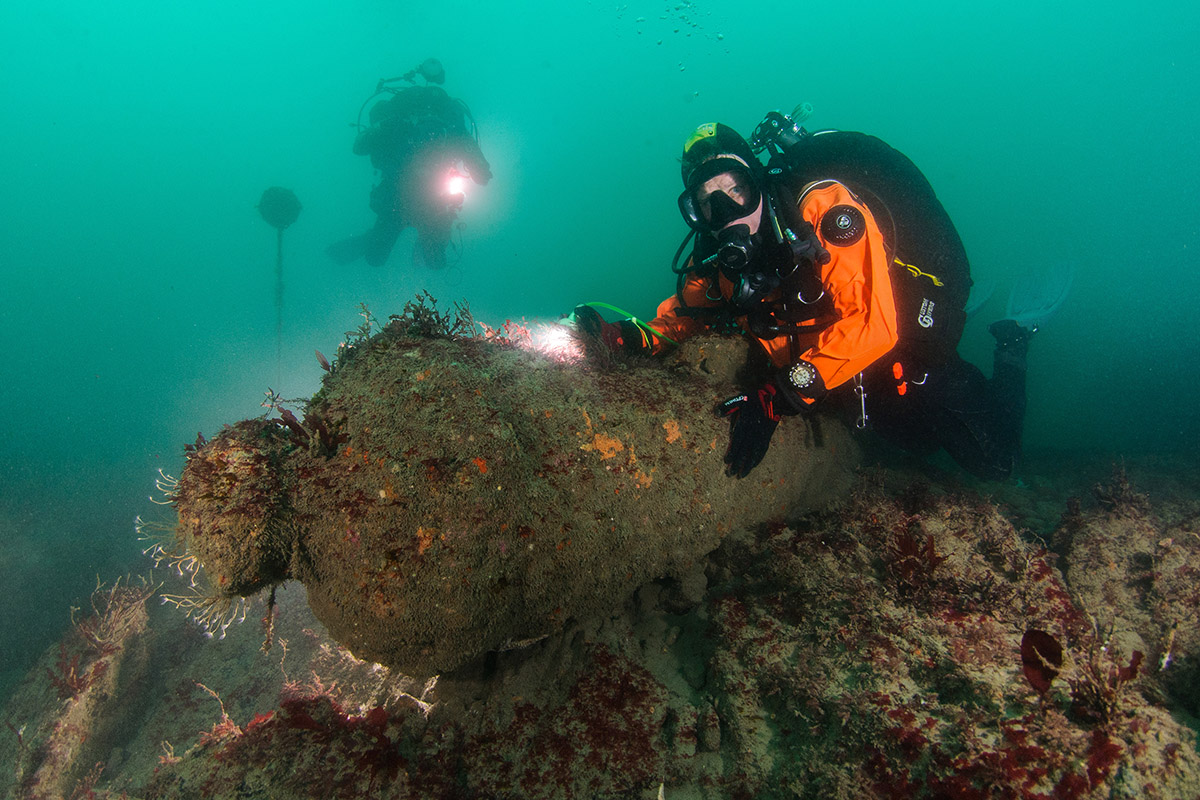
"One of the Coronation’s many cannon now serves as home to a resident conger who is fine with visitors providing they don’t get too close!"
Taking Mark up on his offer to visit the wreck for myself, I joined members of the project team on a visit to the wreck site. With kit loaded onto the project’s Humber 5.2 metre RIB, we set off on a misty morning towards the wreck site. To prevent damage to the site, the project has installed a series of anchored buoys which sit a few metres above the seabed. Skippers can use these to identity areas around the wreck site that are designed as safe to drop their shot lines.

Resident Conger...
What remains of the Coronation now lies on a fairly unremarkable seabed of rocky outcrops and sandy gullies punctuated by the occasional patch of kelp. What the site lacks in marine flora, though, it more than makes up for in an abundance of fauna with the sea life in the area afforded the same ‘no take’ protection as the wreck itself.

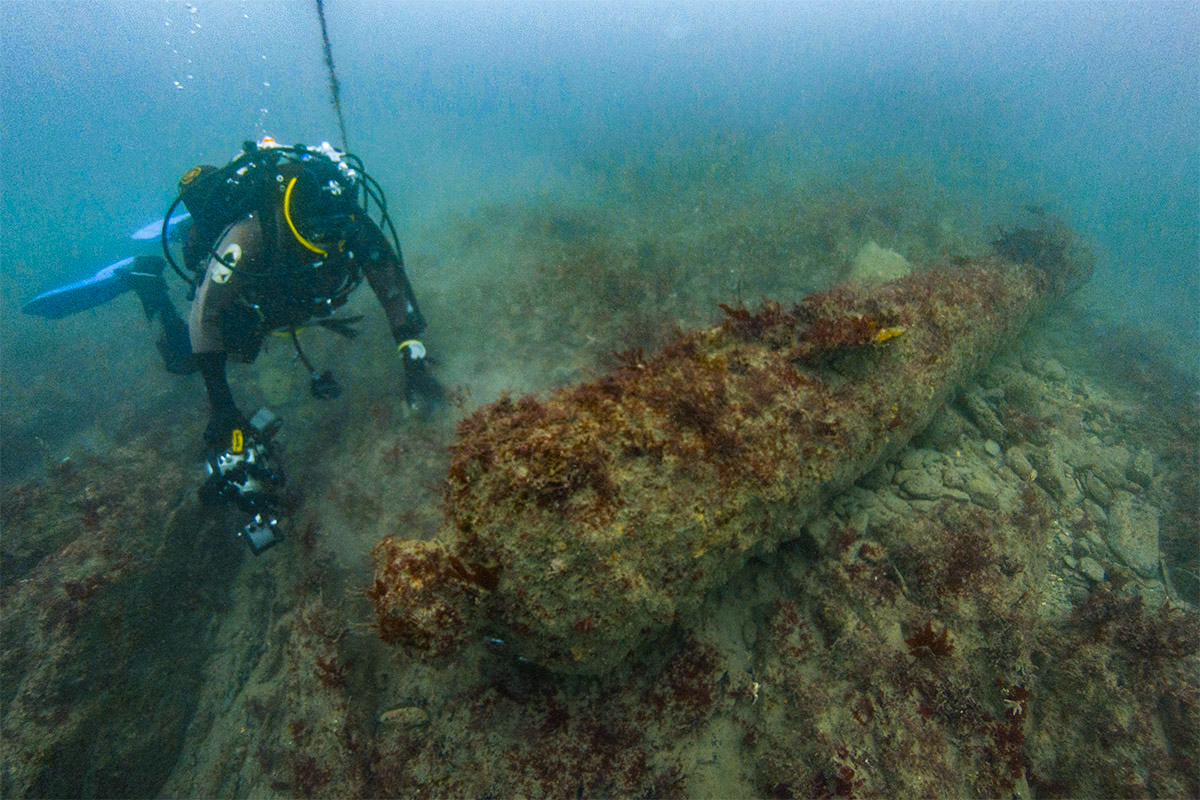
The site is now home to crawfish, lobster, common crab, spider crab, various fish and even the occasional greater spotted dog fish. One of the Coronation’s many cannon now serves as home to a resident conger who, as Mark is keen to point out, is always fine with visitors providing they don’t get too close!

Armed with my trusty laminated ‘divers trail’ slate, navigating around the site is surprisingly easy with both bearings and distances clearly marked between points. To make life even easier, the project has installed a series of ten numbered ‘stations’ which mark the position of various cannon and anchors and also serves as a useful ‘you are here’ indicator to aid the directionally challenged. Even in good viz, it’s worth keeping the slate handy as it’s all too easy to find yourself leaving the wreck site area.
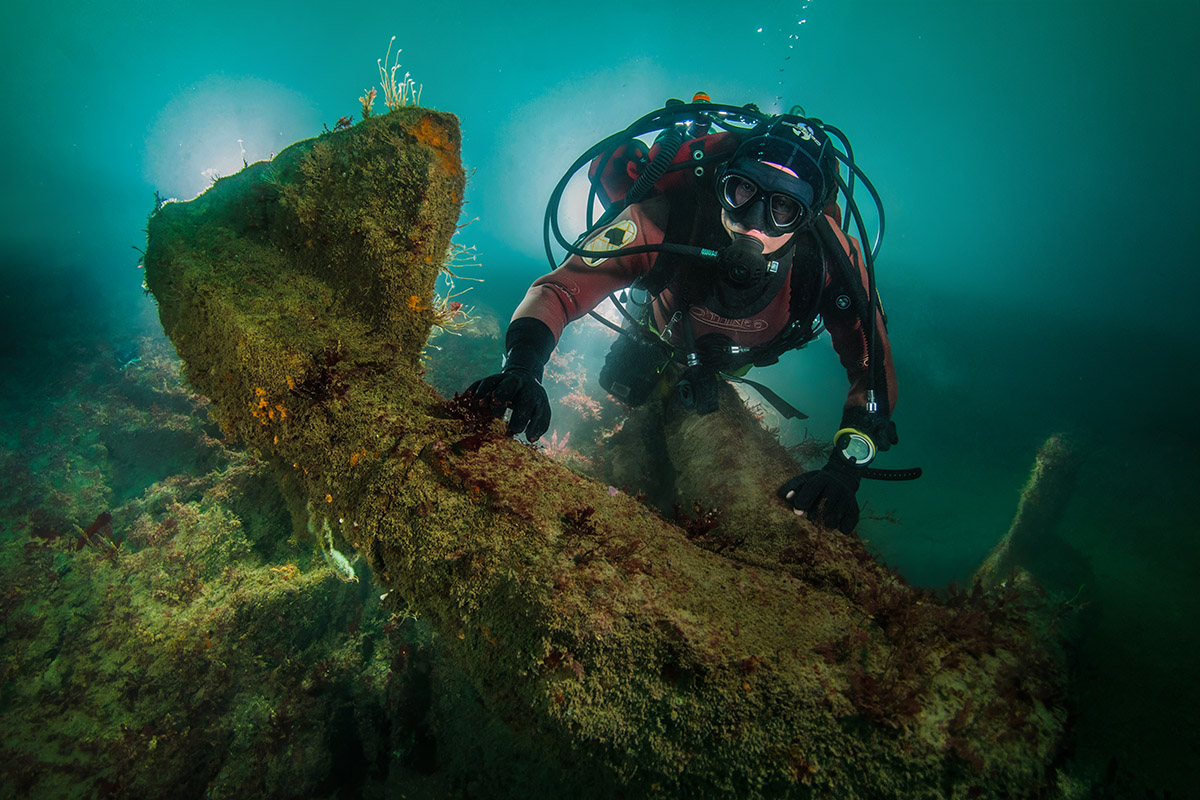
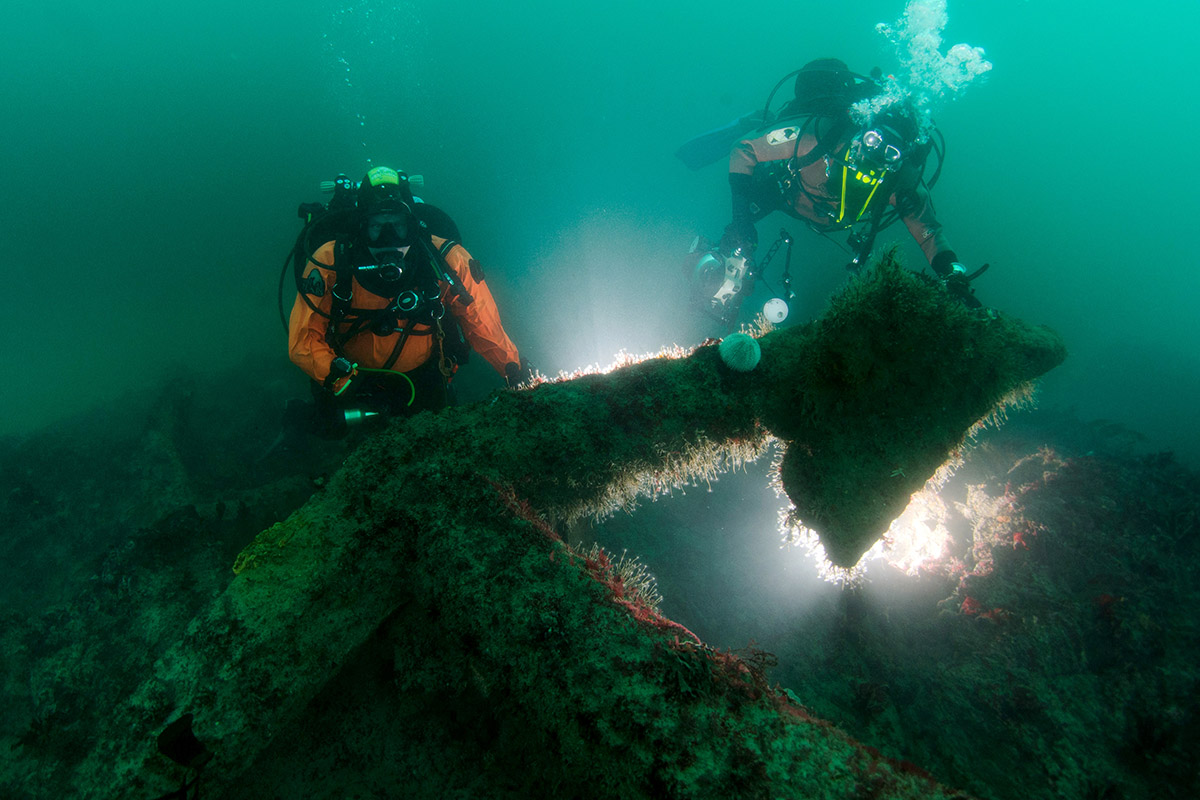
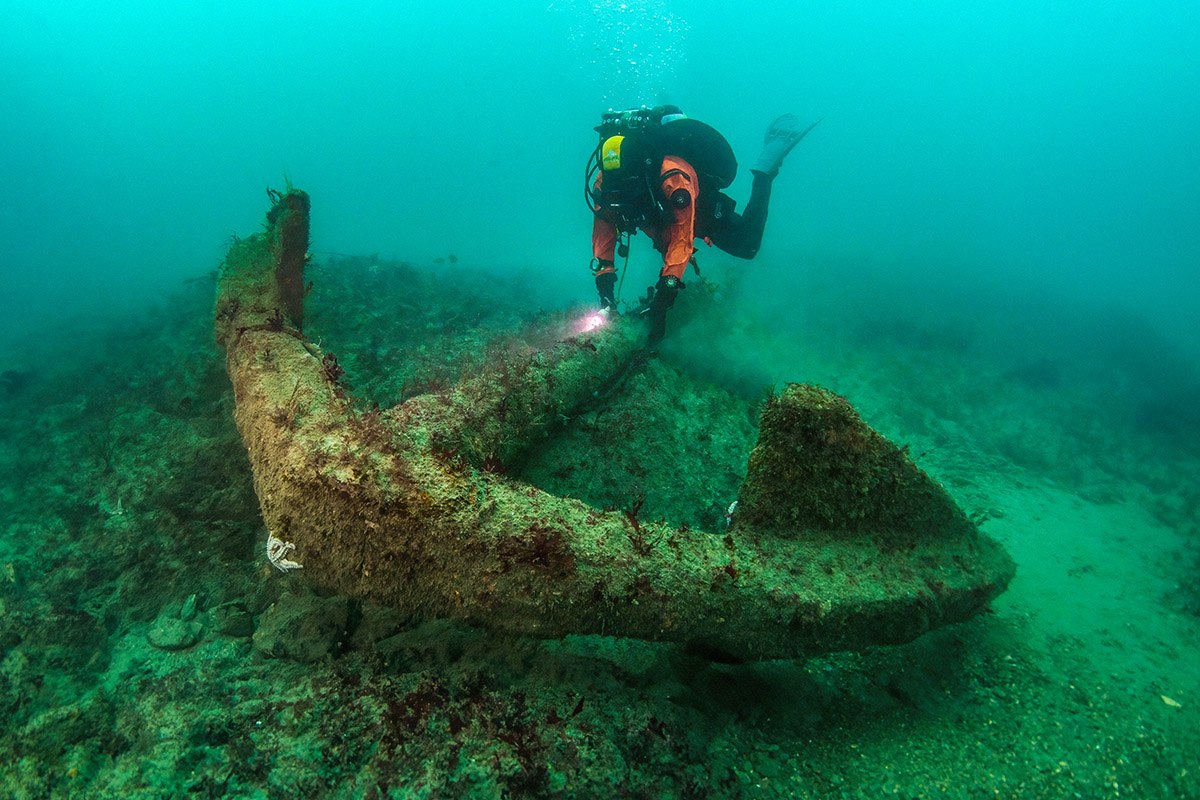
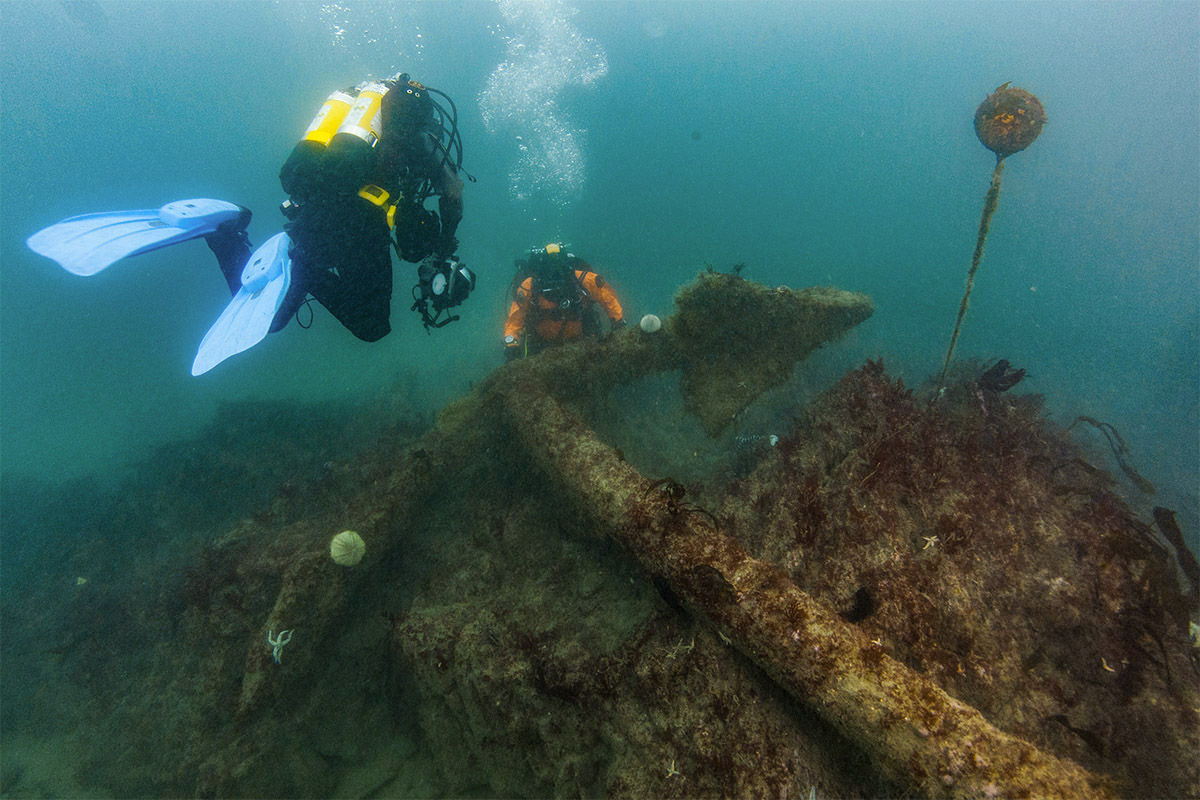
With almost all of the Coronation’s wooden superstructure long gone, what now remains offers a fascinating glimpse into maritime history. Station 1 on the diver trail brings you to the first of two large main anchors. Weighing a good 3.5 tonnes, it’s hard not to be blown away by its sheer size – at 5 metres in length and 2.5 metres in width across the colossal flukes that fan out on either side of the anchor’s crown, it’s hard not to wonder just how big the Coronation herself must have been to need such a behemoth!

Culverin Cannon
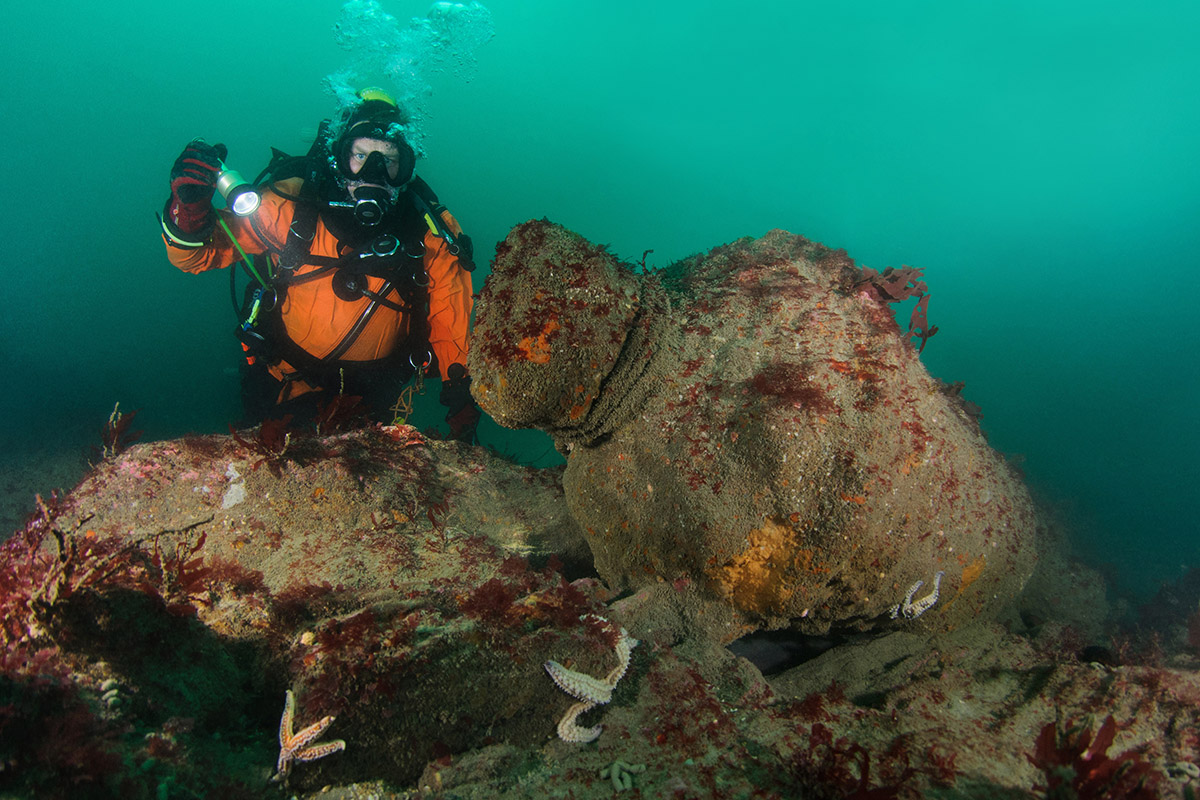
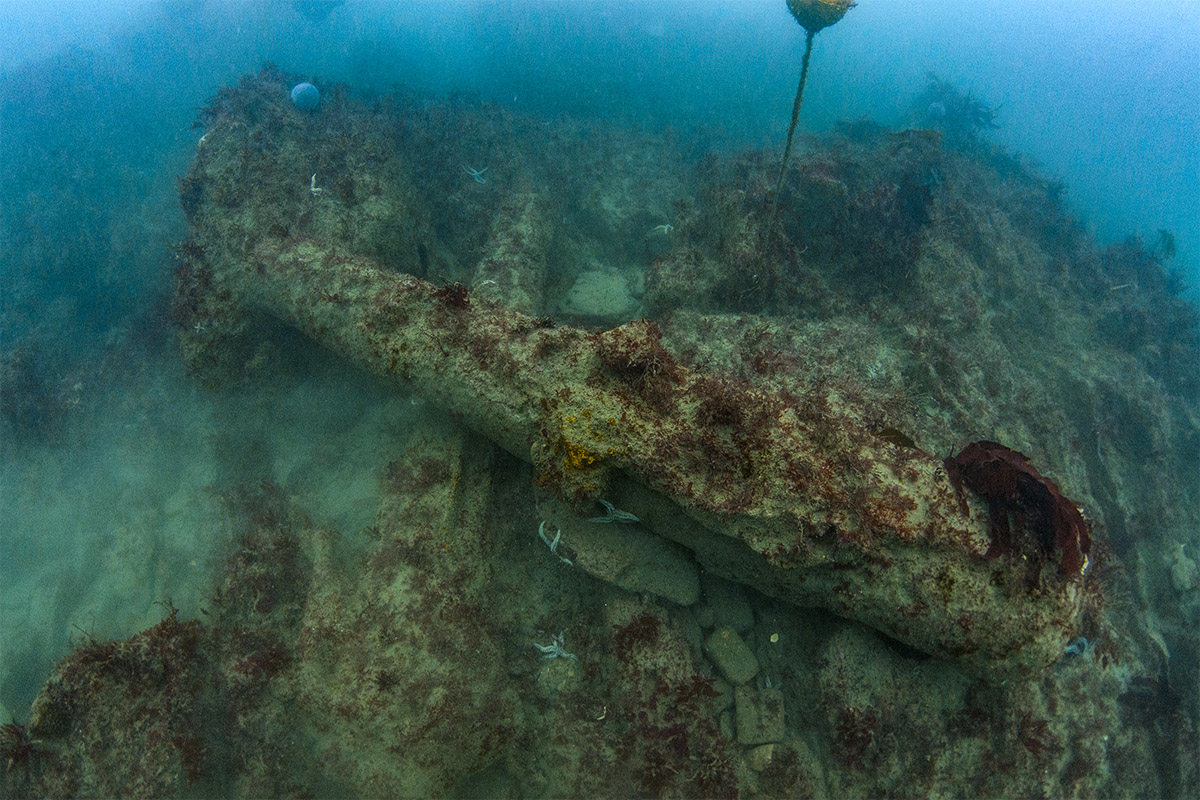
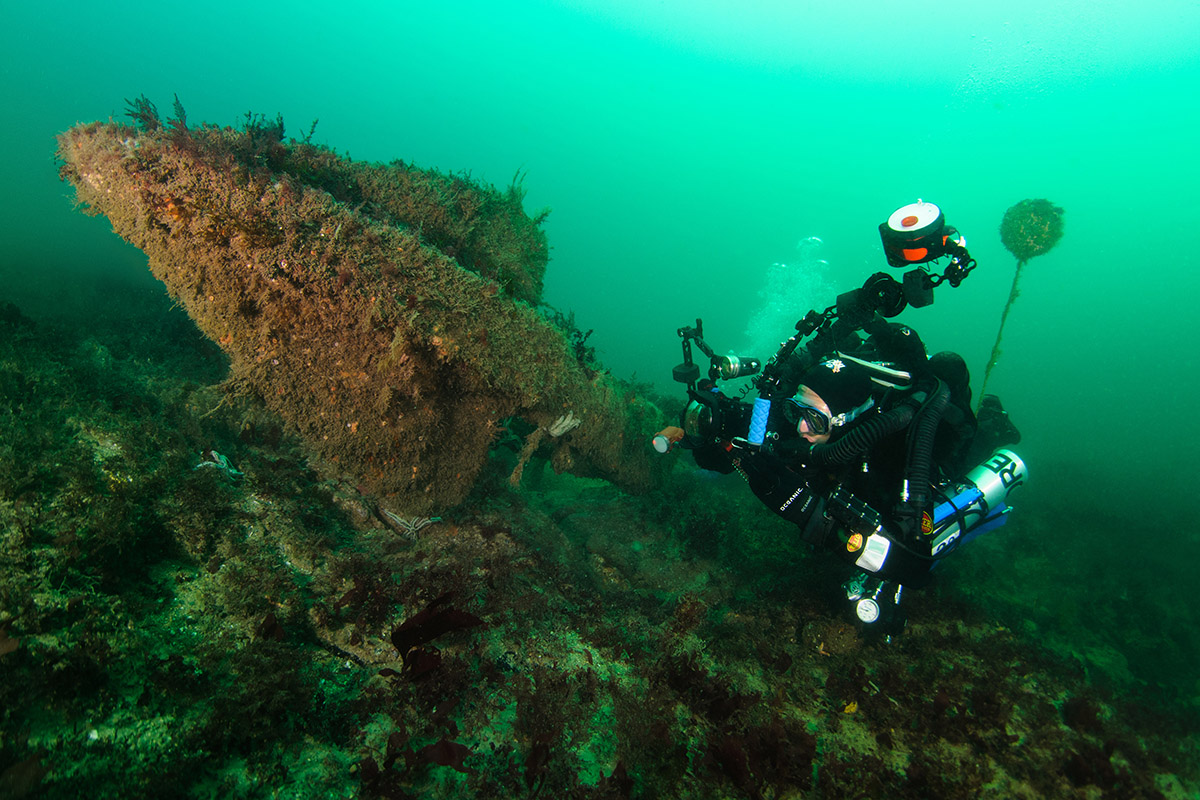
Following the diver trail, you’ll be treated to cannon of many shapes and sizes – from 2.1 metre-long 5.75 pounders to a massive 18 pound ‘Culverin’ cannon measuring over 3 metres in length. Resting on a rocky outcrop, this beauty is a popular stop for visiting photographers! Even this cannon would have been dwarfed by the Coronation’s ‘32 pounder’ cannon from the lower decks which are located off the trail.
"What makes the Coronation such a great dive isn’t just the historic nature of the site but the relatively shallow depth, making it perfect for divers of all levels."
Smaller artefacts are still being discovered around the site, especially in the small gullies where such objects tend to gather. I asked Mark what happens to many of these objects?

“We have lots of smaller artefacts that have be removed from the site over the years. They are currently in storage or being properly preserved and stabilized so that we should soon be able to make the collection available for viewing. In recent times pewter objects and a musket have been lifted from the site. They were uncovered from centuries of silt, and would be lost to the weather if left - they too are being preserved at the moment.”

Glimpse into maritime history
What makes the Coronation such a great dive isn’t just the historic nature of the site but the relatively shallow depth – most of the site is no deeper than 18 metres, making it perfect for divers of all levels. And with the site so close in to shore, it takes less than 20 minutes to arrive.

As divers, we feel a sense of privilege to visit the final resting places of wrecks that offer such a fascinating glimpse into our maritime past. All wrecks have a story to tell but the Coronation’s story is one that eclipses most. She’s a vessel of national importance that marks a time in history when Britain’s dominance of the seas was still being challenged by our European neighbours. A dive on the Coronation is a trip back in time to an age of sail that marked a turning point in our history.
All content © Jason Brown 2010-2026
No content may be reproduced without express written permission.