Home About Portfolio Photo Library Articles & Features
SEARCH
Malta's Ten-Gun Terror
During the darkest months of World War Two, Malta stood firm against the forces of Germany and Italy. Jason Brown uncovers Malta’s wartime past and the wrecks that bare testament to the island's heroism.
Diving the Bristol Beaufighter
off Dragonara Point, Malta...
Few would fail to be captivated by the Maltese islands’ unique mix of medieval towns, ornately decorated churches and charming fishing villages home to Malta’s famous – and brightly painted – ‘luzzu’ traditional fishing boats.

Located in the heart of the Mediterranean Sea less than 60 miles south of Sicily, Malta continues to be a popular destination for visitors from the UK – in 2015 alone, over half a million Brits jumped on a plane and made the 3 hour flight to visit Malta and her sister islands, Comino and Gozo.
Feature Details
Author:
Jason Brown
Publication Date:
February 2017
Publication:
Scuba Diver UK
Feature catagory:
Shipwrecks
Photo Gallery #1:
Photo Gallery #2:

This feature and all images are copyright © Jason Brown and may not be republished, reproduced or copied in any form without the express written permission of the author. This feature and all images are available to licence.
Malta offer glorious sunny weather, beautiful beaches, thriving nightlife and – of course – world class diving. The clear blue Mediterranean Sea that surrounds the islands provides the sort of quality diving that attracts divers from across the world. Malta has it all – reefs, sea caves and more, all within depths to suit all levels of experience and training. Of course what really brings divers to Malta is its wreck diving. Whilst many have been placed in recent years for the purpose of attracting visiting divers, the seas around Malta are home to a number of wrecks that reveal a little of its fascinating wartime past.

The Siege of Malta
It’s all too easy to forget that behind the charm and tranquillity of modern Malta, the islands suffered greatly during World War 2. Reminders of the war can still be found and no visit to Valetta, the tiny capital of Malta, is complete without a tour of the National War Museum in Fort St. Elmo. There you’ll find an array of fascinating exhibits which provide a glimpse into Malta’s wartime past including the Gloster Gladiator biplane ‘Faith’ – one of only three defensive aircraft stationed on the island when Mussolini declared war on the 10th June 1940.

Britain’s wartime prime minister Winston Churchill understood the strategic importance of the Maltese Islands to the war effort. Throughout the war, Axis forces engaged in relentless attacks on the islands in an effort to subdue her. Stuka dive bombers based in Sicily pounded Malta – the heaviest of these attacks taking place during 1942 in what would become known as the ‘Siege of Malta’. On the 15th August, the siege was mercifully broken after the badly damaged remnants of the famous ‘Operation Pedestal’ convoy limped into Valetta harbour carrying life-saving supplies and all-important fuel for the Spitfires tasked with defending the islands.
Whilst many of the ships and aircraft lost during the war years are in waters far too deep for recreational divers, a number of wartime wrecks are located in shallower waters. Perhaps the most famous of Malta’s wartime wrecks is that of HMS Maori – a Tribal class destroyer that was sunk in Valetta’s Grand Harbour in 1942.

Grand Harbour Sinking
In more fortunate times, HMS Maori participated in one of the most historic engagements of the war - the pursuit and eventual sinking of the famous German battleship Bismarck in May 1941. Having located and attacked the mighty battleship the day before, Maori and destroyers Cossack, Sikh and Zulu shadowed the Bismarck throughout the night until the larger British warships could arrive and finish the job. HMS Maori also rescued some of the survivors from Bismarck after the battleship was sunk.

Maori’s luck would run out on the 12th February 1942 when German aircraft sank her at her moorings in the Grand Harbour with the loss of one crew member. She was later removed from the Grand Harbour and scuttled in St Elmo’s Bay at a depth of just 14 metres. Whilst the wreck is not complete – her stern was sunk in deeper water out to sea – much of her forward superstructure is still in evidence, including two front gun bases. Cardinal fish, saddled seabream, camouflaged scorpion and seahorses can often be seen on and around the wreck.
Located not far from the Maori is another war time wreck - the X127 Lighter. Sunk off Manoel Island during an air raid, the ‘Lighters’ were purpose-built landing craft designed for the transportation of troops, horses and field guns during the Dardanelles landings of World War One. After the war, X127 found its way to Malta and was converted to carry fuel oil for submarines. Today she lies upright on a 20 degree slope with her bow at 5 metres and her stern at 22 metres. Although very silty and suffering from poor visibility, the wreck has taken on a new role as an artificial reef with sightings of octopus and cuttlefish not uncommon.

Bristol Blenheim Bomber
If you’re looking for something a little bit different, Malta offers the opportunity to visit two wartime aircraft wrecks. The first – and perhaps the better known of the two – is the Bristol Blenheim Bomber located approximately 800 metres due east of Xrobb l-Ghagin at a depth of 42 metres. The Blenheim was heavily damaged shortly after take-off after being engaged by enemy aircraft. Fearing that the damaged aircraft could make the runway inoperable, the pilot ditched the aircraft in the sea. All three crew members escaped with only minor injuries as the aircraft sank beneath the waves.

Seventy years on, the wreck of the Blenheim Bomber is still reasonably intact with both wings and its twin Bristol Mercury engines (one of which still has its battered propeller in place) easy to make out as you descend the shotline through the clear Mediterranean waters. Due to the force of impact when the aircraft ditched in the sea, the fuselage has broken away from the cockpit and wing section and now lies upside down on the opposite side of where it should be! Look out too for the pilot’s control column and seat which is still in situ.
"With its six wing-mounted machine guns and four fuselage-mounted cannons, the Beaufighter earnt the nickname ‘the ten-gun terror’"
One of the more recent wartime wrecks to be discovered off the Maltese coastline is that of another allied aircraft – a Bristol Beaufighter. The Beaufighter was a long-range, multi-role heavy fighter that enjoyed a distinguished career throughout the war. With its six wing-mounted machine guns - four on the starboard wing and two on the port wing - and four fuselage-mounted cannons, the Beaufighter earnt the nickname ‘the ten-gun terror’. She was fast too at over 330mph, second only to the famous Mosquito!

Malta’s Beaufighter wreck was discovered quite by chance in the late 70s by Vincent Milton – the founder of popular St Julians dive centre Divewise Malta – who stumbled across it whilst surveying the local reefs surrounding St Julians. Even then, the wreck would remain a mystery until Vincent and his son Patrick returned to identify it many years later. These days the Beaufighter is a popular logbook addition for many visiting divers.

Strike on Axis Shipping
Laying at a depth of 37m approximately 800mm off Dragonara Point, Beaufighter ‘N’ (serial number T5174) was attached to 272 Squadron of the Royal Airforce and crewed by Sgt Donald Frazee and Sgt Sandery. On the 17th March 1943, Beaufighters from 272 Squadron took off to escort nine Beaufort torpedo bombers on a strike against axis shipping off Point Stelo in Sicily.

Not long after take-off, Frazee and Sandery’s Beaufighter began to vibrate and lose speed. With a safe landing unlikely, Sgt Frazee successfully ditched the aircraft into the sea and both he and Sandery rapidly vacated the aircraft as it began to sink. Both crew members were picked up by local fishing boats and transferred to a rescue launch.
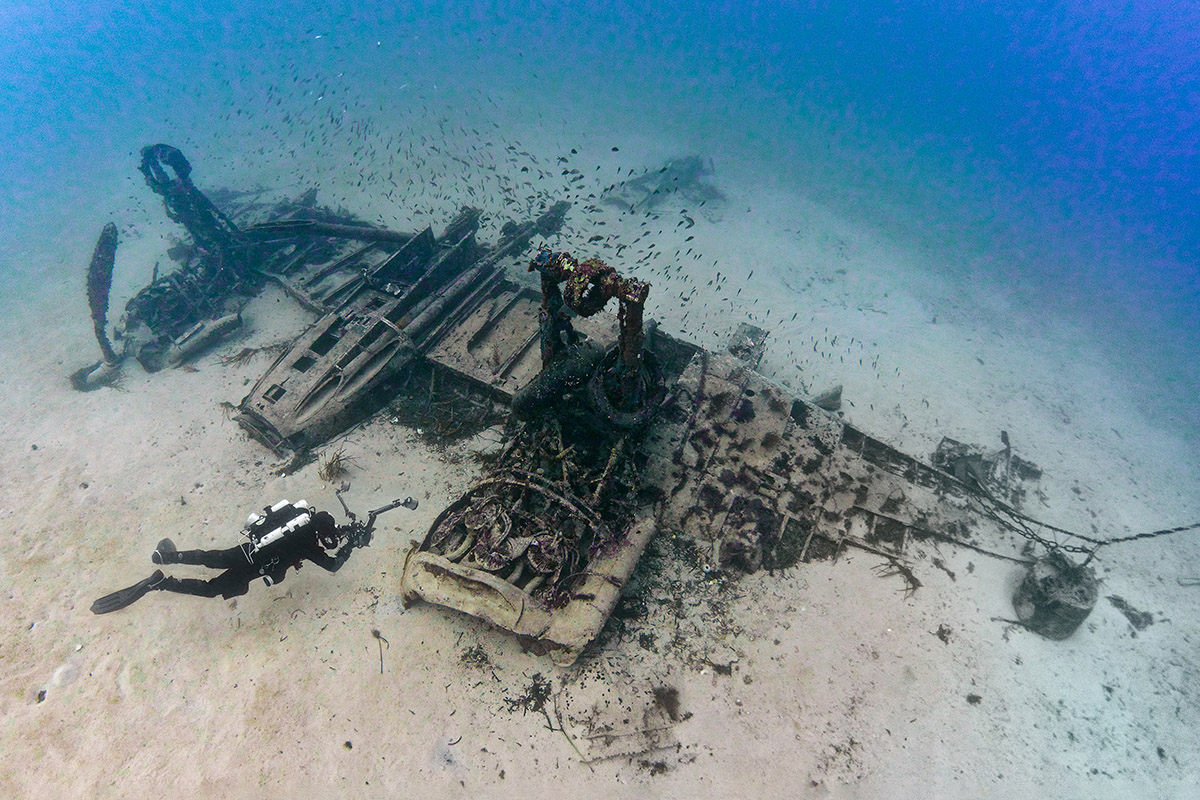
Today what remains of the Beaufighter lies upside down on a clean, white sandy sea bed at a depth of 37m. Accessible only by boat, diving the wreck is nonetheless a relaxed and enjoyable experience. To protect the wreck from badly-placed shots and anchors, a permanent block and line has been placed near the wreck to remove the need for visiting boats to shot the wreck for themselves. This line buoy needs replacing on a regular basis as the wrecks sit in the main path for boat traffic travelling to and from the islands of Gozo and Comino.

Colourful Marine Growth
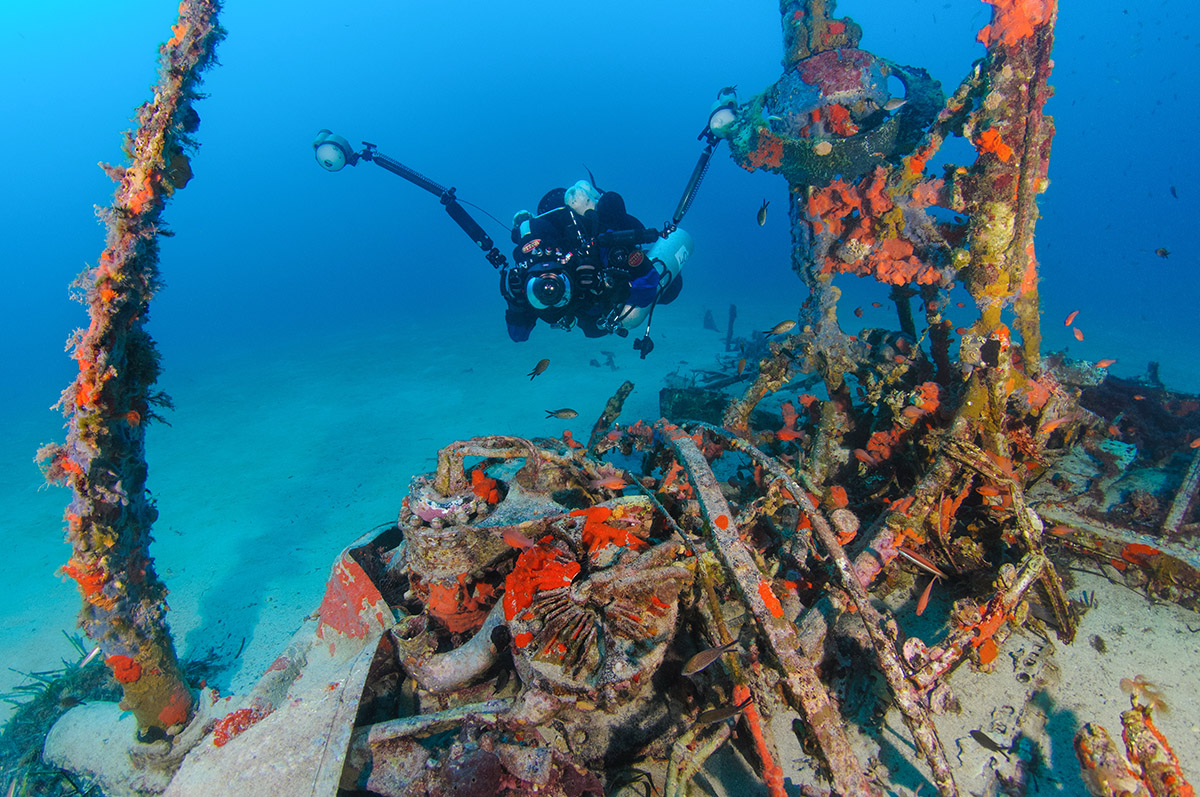
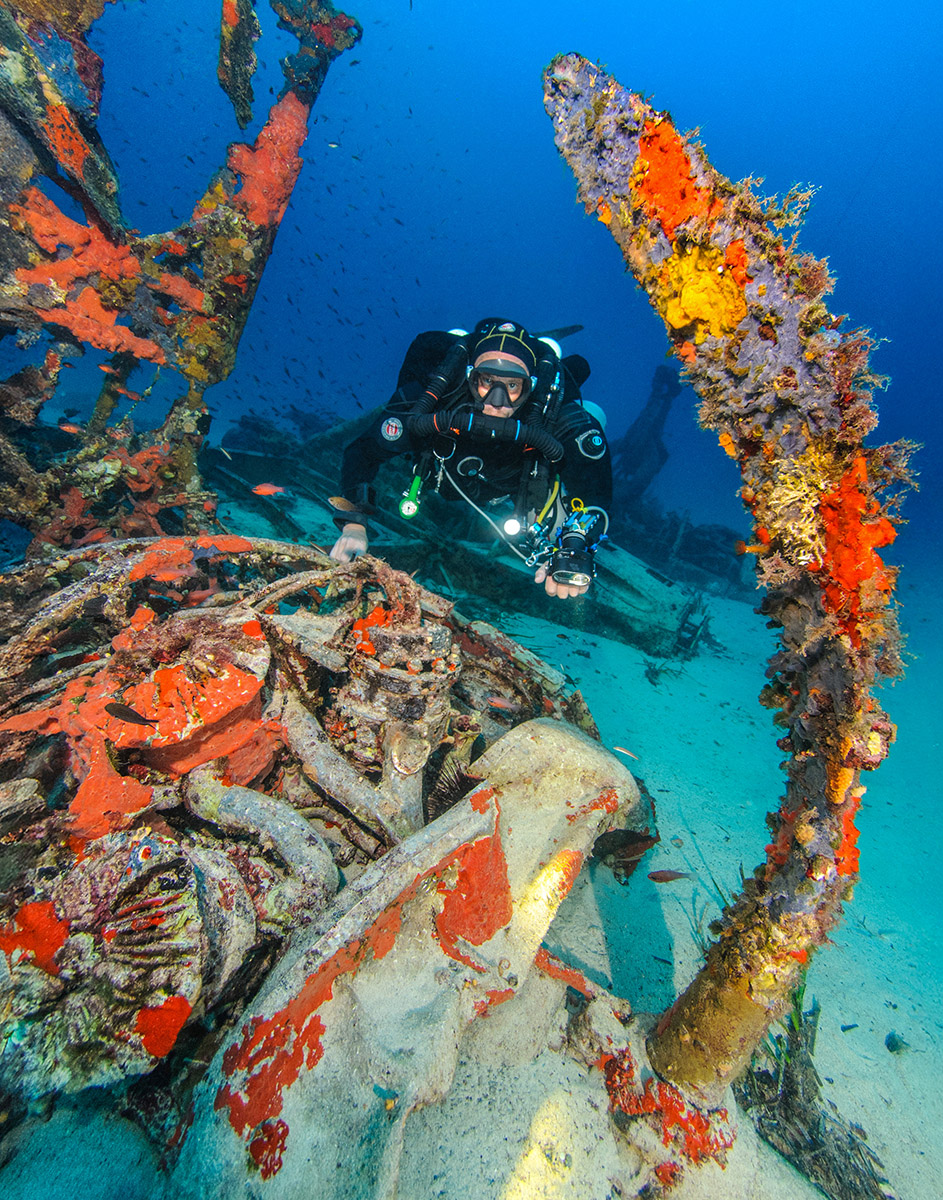
Dropping down the shotline, the outline of the wreck begins to appear through the haze. It’s clear that even after seventy odd years on the sea bed, the lightweight airframe is in surprisingly good condition. Partially buried and laying upside down in the sand, only the tail section of the fuselage is missing from an otherwise complete wreck. Rising up from the wings on either side of the centre fuselage, both undercarriage frames remain locked in the landing position. Covered in colourful marine growth, their shredded and degrading rubber hang limply from their hubs.

The real attraction are the aircraft’s twin supercharged Hercules engines. Although partially buried in the sand, much of the engine’s workings including its array of radial cylinders can clearly be seen. Like the Blenheim Bomber, the Beaufighter has lost one of its two propellers. Considering the speed at which she must have hit the water, it’s a miracle that either of them stayed in place!

For visiting photographers, no dive on the Beaufighter is complete with at least one shot of the port engine with its twisted propeller particularly buried in the sand. Look out too for the four ports that housed the aircraft’s death-dealing 20mm Hispano cannons, one of which is now bent upwards at a 45 degree angle. These destructive weapons of war now serve as home for a pair of moray eels that have taken up residence around the wreck.
A Monument to Defiance
The Bristol Beaufighter wreck is a compact site which doesn’t take long to explore – even on a single cylinder, you could take a complete tour of the site without busting your computer's no stop limits. That’s not to say that the Beaufighter has limited appeal. Far from it. Where else can you dive a 'real' WW2 fighter aircraft that’s still in a reasonably good condition and offers such a fascinating back story?

It’s enthralling to think that the tangled and twisted metal remains now laying on the sea bed off St Julian's was once engaged in the airborne defence of Malta – an island that suffered constant bombardment by the Luftwaffe but remained fiercely defiant throughout. The Beaufighter isn’t just another ‘tourist’ wreck – it’s a lasting monument to the tenacity and vigilance of the RAF and the brave people of Malta. It’s a genuine and important part of history and, for that reason and more, it’s an entry worthy of any diver's log book.
All content © Jason Brown 2010-2026
No content may be reproduced without express written permission.